Filed under
⌈ Hermeneutics ⌋

Stylized illustration of a film director operating a vintage motion-picture camera mounted on a tripod, peering through the viewfinder while adjusting the pan handle.

“And” Is Not Always And

Καί and δέ do more than translate as “and” or “but.” They help frame the flow of thought. Καί holds ideas together in one shot; δέ moves the camera to the next development. Learning the difference keeps readers from overloading English conjunctions with meanings Greek may not intend.
2026 | 07 | 15
Articlette

by Thani

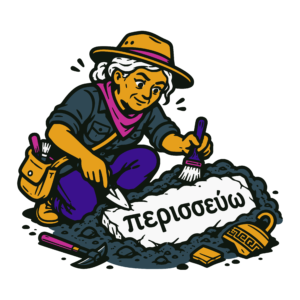
Stylized illustration of an elderly archaeologist carefully excavating an ancient stone slab engraved with the Greek word περισσεύω (perisseuō).

Words in Their World

Word studies can clarify Scripture—or badly distort it. This article shows how to move beyond dictionary shortcuts by tracing a word’s lemma, lexical range, and contextual use, so the word is heard in its own sentence, argument, book, and world.
2026 | 07 | 15
Article

by Thani

Illustration of a flowering plant growing from two distinct layers of soil, with its roots extending deep into the lower layer.

The Force Beneath the Phrase

Words do more than state facts. Illocutionary force helps us ask what a speaker is doing through the words: warning, comforting, rebuking, inviting, or strengthening. Without context, we may preserve the sentence while missing the communication.
2026 | 07 | 08
Articlette

by Thani

Illustration of a chef's knife slicing through an onion, exposing its tightly packed concentric layers.

Each Letter has a Voice

Words do more than state facts—they comfort, warn, defend, and strengthen. Using 1 Thessalonians as a guide, this article shows how rhetorical context helps us hear Paul’s voice: not as cold doctrine or prophecy-chart speculation, but as a spiritual father steadying a pressured church.
2026 | 07 | 07
Article

by Thani

Illustration of a puzzled young woman comparing two Greek theatre masks, one tragic and one comic, while a question mark hovers above her head.

Litotes

Litotes is emphasis by denial: saying “not bad” to mean “pretty good,” or “no small stir” to mean serious unrest. Scripture uses this ordinary figure of speech too. Learning to spot it keeps readers from forcing wooden meanings where the author meant emphasis.
2026 | 07 | 06
Articlette

by Thani

Illustration of Sherlock Holmes pointing upward as if explaining an idea, while Dr. John Watson beside him looks skeptical and thoughtful.

The Inductive Bible Study Method

Most people read Scripture like Sherlock Holmes—jumping straight to conclusions. But the Bible demands a slower path: observation before interpretation, and interpretation before application that actually transforms life.
2026 | 04 | 25
Article

by Thani

Illustration of a group of people standing closely together, all looking upward with anticipation at a large cloud hovering above them.

The Seven Phases of Divine Communication

Scripture didn’t drop from heaven into your hands. From revelation to application, it travels a long path—one that ends not in interpretation, but in a transformed life empowered by God’s Spirit.
2026 | 04 | 18
Article

by Thani

Vector-style artwork of a cheerful young man crouched beside an open file box, reading a letter with a captivated expression.

Reading Someone Else’s Mail

Many believers unintentionally open someone else’s mail in Scripture—claiming promises or commands never addressed to them. The key is learning the difference between primary application (what it meant to the original audience) and secondary application (what we can learn from it). When we read the Bible’s letters as they were sent, God’s voice grows clearer, not smaller.
2025 | 11 | 27
Article

by Thani

Bold vector-style cartoon illustration of a compass rose with alternating purple and gold points. Around the compass are small icons: (clockwise starting at the top) target, brick, magnifying glass, scroll, book pile, globe, clock, tornado, line graph, speech graphic, chain links, and DNA strand. Outlined in thick black lines with flat gold, purple, pink, and teal colors in a clean sticker-like style.

The Context Compass

Interpreting Scripture can feel like wandering in the wilderness—every verse pulling a different way. The Context Compass (C12) offers bearings: twelve “directions” of context that orient us to author, history, genre, and theology. Not a rigid map, but a compass—guiding readers toward clarity without losing the text’s voice.
2025 | 09 | 16
Article

by Thani

Vector-style cartoon illustration of four people standing in a police lineup, each holding a numbered placard. From left to right: a man in a headwrap with the number 1, a woman in a headscarf with the number 2, a man in a jacket with the number 3, and a woman with short dark hair wearing a pink shirt with the number 4. Behind them are lineup height lines. Outlined in thick black lines with bold flat colors, the design has a clean, sticker-like style on a transparent background.

Who Said That?

The Bible is God’s Word for us—but not every line was written to us. Confusing the author, recipient, speaker, and audience can twist meaning and create contradictions. Learning to track these “four parties of Scripture” clears the noise and lets us hear God’s Word as it was meant.
2025 | 08 | 27
Article

by Thani