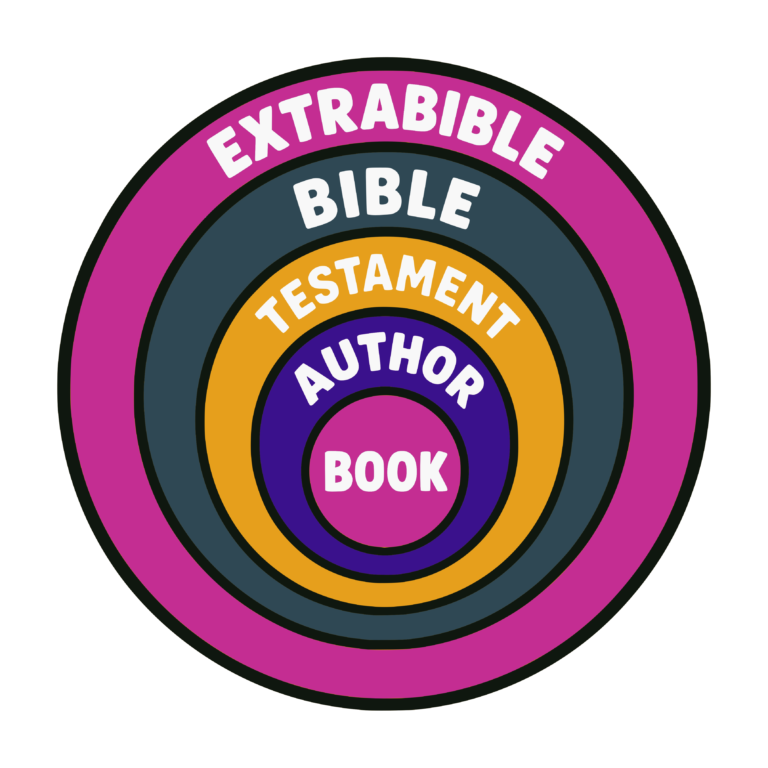
What is chiasmus? Chiasmus is what? That is chiasmus. The word comes from the Greek letter chi (Χ), because if the corresponding parts of a chiasm were connected by lines, those lines would cross like an X: A–B–B′–A′, or A–B–C–B′–A′. It is literary symmetry built by traveling through a sequence of ideas and then returning through them in reverse order. Think mirror, not merely repetition.
Repetition simply says something again; chiasmus makes the repetition architectural, positioning matching words, ideas, characters, actions, or scenes opposite one another so that the reader moves inward and then outward again. In its clearest forms, everything turns around a central element called the crux (also pivot or center).
The middle is the message.
Scholars of biblical chiasmus have repeatedly identified this central turning point as one of the strongest marks of genuine concentric structure (Lund 1942; Breck 1987, 70–74).
You Already Know This Move
Chiasmus is not as foreign as it sounds. Modern English still preserves a miniature version of it in antimetabole, where words or grammatical elements repeat in reverse order: Shakespeare’s “Fair is foul, and foul is fair”; the familiar saying, “When the going gets tough, the tough get going”; or John F. Kennedy’s “Ask not what your country can do for you—ask what you can do for your country.” We still like language that folds back on itself.
Even nursery rhymes work this way:
A Hickory dickory dock
B The mouse ran up the clock
X The clock struck one
B‘ The mouse ran down
A′ Hickory dickory dock
Notice the arrangement. We enter through the repeated opening, move upward with the mouse, reach the clock’s strike, and then reverse direction until we arrive exactly where we began. Larger chiasms operate by the same basic principle, except their corresponding elements may stretch across entire paragraphs, stories, or even a whole book of the Bible rather than five lines. The “bow tie” can get very large.
When Scripture Repeats Itself
Here’s an obvious example in Scripture. Genesis 11:1–9, the account of Babel, contains enough repeated vocabulary and inverted action that its architecture becomes difficult to dismiss; introductory and concluding references to “the whole earth” and “language” surround humanity’s construction, fear of being scattered, and God’s corresponding intervention (Duvall and Hays 2020).
One simplified way of displaying the movement is:
A The whole earth has one language (Genesis 11:1)
B Humanity says, “Come, let us” build (11:3–4)
C “Lest we be scattered abroad” (11:4)
X “But the LORD came down” (11:5)
C′ The LORD scatters them abroad (11:8)
B′ They cease building the city (11:8)
A′ The LORD confuses the language of all the earth (11:9)
The center is almost comic! Humanity has constructed a tower “whose top is in the heavens,” yet the narrator immediately tells us that “the LORD came down to see the city and the tower” (Genesis 11:4–5). Their monumental ascent is so small from heaven’s perspective that God must descend to inspect it. The structure sharpens the irony.
Psalm 67 is even cleaner. Its repeated refrain—“Let the peoples praise You, O God; Let all the peoples praise You”—creates unmistakable matching “wings” around a central invitation to worldwide rejoicing, while the opening and closing blessings upon Israel create the outer frame (Amzallag 2015, 171–87).
A God blesses us, so His way may be known among the nations (Psalm 67:1–2)
B “Let the peoples praise You” (67:3)
X “Let the nations be glad and sing for joy!” because God judges and governs rightly (67:4)
B′ “Let the peoples praise You” (67:5)
A′ God blesses us, and “all the ends of the earth shall fear Him” (67:6–7)
The repetition points somewhere: Israel’s blessing and the nations’ praise converge upon the central picture of the nations rejoicing beneath God’s righteous rule. The refrain guides us inward.
More Than Matching Words
But exact words are only one kind of mirror. Consider:
- Lexical — the same words or phrases recur in reverse order.
- Syntactical / grammatical — grammatical relationships reverse, even when the wording changes.
- Conceptual / thematic — corresponding sections discuss the same ideas without repeating identical vocabulary.
- Motivic / narrative — characters, places, objects, conflicts, or events recur in reverse sequence.
- Rhetorical / structural — whole units of argument, dialogue, exhortation, or narrative correspond across a central turning point.
(Scholars do not use one universally fixed taxonomy for chiastic correspondences, so these categories should be treated as useful descriptions rather than rigid species; nevertheless, learning the different ways texts can correspond prevents us from searching only for repeated vocabulary [Rappleye 2020, 289–309])
These forms regularly overlap. A strong chiasm may begin with a repeated word, reinforce the pairing through similar grammar, develop the same concept, and finally reveal that two entire scenes perform matching functions in the story. That cumulative evidence matters because a reader can manufacture flimsy “parallels” almost anywhere if vague similarities are allowed to count. Good chiasms usually have more than one witness.
The Center of Gravity
Here is the reason any of this matters: a chiasm is not decorative. In a well-formed concentric structure, the corresponding elements act like hallways leading toward a central room; they establish categories, contrasts, questions, expectations, and tensions that converge upon the crux, after which those same elements return in altered light. The center therefore commonly functions as the architect’s interpretive pivot—the idea around which the rest of the unit has deliberately been arranged (Breck 1987, 70–74).
This can change interpretation dramatically. Modern readers tend to assume that an author’s main point will arrive at the beginning as a thesis or at the end as a conclusion, so we naturally privilege the first or final statement; concentric rhetoric can instead place the controlling emphasis in the middle. If we identify the wings but ignore what they surround, we may carefully interpret every brick while tragically overlooking the doorway the architect built them around. Finding the structure can reveal the argument.
That does not make the wings disposable. The outer elements explain why the center matters, supply the categories by which it should be understood, and frequently reinterpret one another across the mirror; Babel’s language, building, and scattering are all essential to understanding why the LORD’s descent is such a decisive reversal. The crux controls the structure without erasing it.
The middle is the message,
but the mirror gives it meaning.
When Structure Changes Interpretation
Large chiasms make this easiest to feel. The Flood narrative of Genesis 6–9 has long been recognized by many scholars as containing a broad mirrored movement; strikingly, those proposals repeatedly converge upon Genesis 8:1 as the great turning point: “Then God remembered Noah” (Wenham, as discussed in subsequent treatments of the narrative).
In very broad strokes, the story moves like this:
A Noah, his family, and the animals enter the crisis
B Waters increase
C Creation disappears beneath judgment
X “Then God remembered Noah” (Genesis 8:1)
C′ Creation begins appearing again
B′ Waters decrease
A′ Noah, his family, and the animals emerge into the renewed world
Suddenly, one sentence carries enormous structural weight. “God remembered Noah.” It is not suggesting that Noah had slipped God’s mind and abruptly returned to it; within the narrative architecture it signals the decisive turn from uncreation toward recreation, from rising waters toward receding waters, and from judgment toward deliverance. Everything before Genesis 8:1 descends toward death; everything afterward climbs toward life. The whole Flood turns on remembrance.
That is conceptual and narrative chiasmus rather than simple wordplay. The corresponding elements are movements—entering and leaving, increasing and decreasing, destruction and restoration—and the author’s arrangement helps the reader understand what the story is doing rather than merely what happens next. Structure becomes interpretation.
Learning to See the Pattern
Start with what you can easily see. Take a reasonably bounded passage and temporarily remove the paratext—chapter headings, paragraph headings, cross-reference notes, and even verse numbers and line breaks—then look for unusual repetitions, matching scenes, repeated questions, changes of speaker, recurring characters, parallel commands, or an inclusio, where similar language frames the beginning and ending of a unit. Follow the repetitions before inventing a theory.
Then work inward. Mark the clearest correspondences first, place matching elements opposite one another as A/A′, B/B′, C/C′, and ask whether the pairings continue in a reasonably balanced order toward an identifiable turning point; if they do, examine that center carefully and then work back outward to see whether it actually explains the surrounding material. Colors help: highlight corresponding ideas alike and see whether the passage begins to resemble a rainbow folding back upon itself. Let the text build the chiasm.
Natural boundaries matter too. Strong proposals account for major material rather than skipping inconvenient sentences, use distinctive words or substantial ideas rather than generic similarities, and become more persuasive as multiple independent correspondences accumulate; the proposed center should also make rhetorical sense as a genuine climax or turn (Rappleye 2020, 289–309). A convincing mirror will survive inspection.
Learning Not to See Too Much
Once you learn to see chiasms, you may begin seeing them everywhere—and because Scripture naturally contains repetition, parallelism, recurring themes, and similar vocabulary, an imaginative reader can unintentionally force almost any long passage into something resembling A–B–C–B′–A′. A pattern is not proved merely because it can be drawn.
The Biblical Chiasm Exchange is a fascinating communal database containing proposed structures from across Scripture, including large-scale structures for entire books, but the site itself appropriately describes all its proposals as provisional. Use resources like it as a workshop, not an answer key: always compare proposals with the text, ask whether their pairings are specific rather than vague, and remain willing to decide that a passage contains ordinary parallelism, an inclusio, repetition, or no deliberate symmetry at all.
Chiasms are as easy to overstate as they are to overlook.
The goal is not to become a chiasm hunter. It is to become a better reader—one who notices not only what biblical authors say but how they have arranged what they say, allowing grammar, vocabulary, rhetoric, narrative, and structure to participate together in interpretation. Read the architecture, not just the bricks.
You Just Read One
We are back where we started. We began with the definition, moved through familiar modern examples, entered obvious biblical repetitions, widened those repetitions beyond vocabulary, reached the interpretive importance of the crux, and then traveled outward again through conceptual examples, practical identification, and cautions for the modern reader. The article folded back upon itself.
That was intentional! Its sections form their own broad pattern:
A definition
B familiarity
C visible repetition
D kinds of symmetry
X why chiasms matter
D’ deeper symmetry
C’ finding repetition
B’ disciplined familiarity
A’ definition
So what is chiasmus? This whole article is chiasmus. And what does chiasmus do?
It makes the middle the message.
Bibliography
- Amzallag, Nissim. 2015. “Psalm 67 and the Cosmopolite Musical Worship of Yhwh.” Bulletin for Biblical Research 25 (2): 171–87.
- Breck, John. 1987. “Biblical Chiasmus: Exploring Structure for Meaning.” Biblical Theology Bulletin 17 (2): 70–74.
- Duvall, J. Scott, and J. Daniel Hays. 2020. Grasping God’s Word: A Hands-On Approach to Reading, Interpreting, and Applying the Bible. 4th ed. Grand Rapids, MI: Zondervan Academic.
- Lund, Nils Wilhelm. 1942. Chiasmus in the New Testament: A Study in Formgeschichte. Chapel Hill: University of North Carolina Press.
- Rappleye, Neal. 2020. “Chiasmus Criteria in Review.” In Chiasmus: The State of the Art, edited by Donald W. Parry and John W. Welch, 289–309. Provo, UT: BYU Studies.
- Wenham, Gordon J. 1978. “The Coherence of the Flood Narrative.” Vetus Testamentum 28: 336–48.